



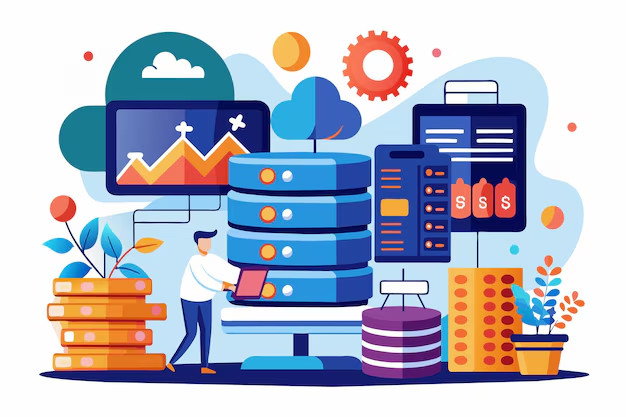
Data Flow & System Communication: The Backbone of Modern Digital Platforms
In modern digital systems, data flow is what connects every component into a functioning whole. Applications, databases, APIs, and services rely on continuous communication to operate efficiently across distributed environments. Without structured data movement, even the most advanced systems fail to deliver consistent results under real-world conditions. Data flow defines how information is transmitted, processed, validated, and utilized across the entire system, ensuring that each component receives the correct data at the right time with minimal latency.
For technology infrastructure companies like NexTechInfra, understanding and optimizing data flow is critical to building scalable and reliable systems. It ensures that user actions are processed in real time, systems remain synchronized across multiple services, and business operations are executed without delays or inconsistencies. Efficient data flow also enables systems to handle increasing loads, integrate with external services, and maintain stability as complexity grows.
Understanding System Communication
System communication refers to how different components interact with each other within a digital environment. This includes client-server interactions, API requests, database queries, message queues, and communication between microservices. Each interaction must be designed to be efficient, secure, and reliable to maintain overall system performance and prevent breakdowns in data exchange.
Poor communication design leads to bottlenecks, increased latency, data inconsistencies, and system instability. Inefficient routing, excessive requests, or lack of proper synchronization can slow down operations and impact user experience. Efficient communication ensures that data is transmitted quickly, processed correctly, and delivered to the appropriate component without unnecessary delays or resource overhead.
Role of APIs in Data Exchange
APIs act as the bridge between different system components, enabling structured and controlled data exchange. They define how data is requested, transferred, authenticated, and processed between services. A well-designed API ensures consistency, reduces system complexity, and allows components to scale independently without creating tight dependencies between services.
API efficiency directly impacts system performance. Optimized endpoints, proper request handling, rate limiting, and structured responses reduce processing overhead and improve response times. Efficient APIs ensure smooth system interaction even under heavy load, enabling systems to maintain performance, reliability, and scalability as usage increases.

Data Consistency and Synchronization
Maintaining data consistency across systems is one of the most challenging aspects of system design. When multiple services interact in distributed environments, data must remain synchronized to avoid inconsistencies, duplication, or loss. This requires proper handling of transactions, synchronization strategies, concurrency control, and validation mechanisms that ensure data integrity across all system layers.
Techniques such as eventual consistency, intelligent caching, replication strategies, and distributed data management help ensure that systems remain reliable while handling large volumes of data. These approaches balance performance and accuracy by allowing controlled delays in synchronization while maintaining overall system integrity, enabling systems to operate efficiently at scale without compromising reliability.
Latency and Performance Optimization
Latency directly affects how quickly a system responds to user actions. High latency introduces delays in data processing and transmission, negatively impacting user experience and operational efficiency. Optimizing data flow involves reducing unnecessary requests, improving network efficiency, minimizing processing overhead, and ensuring that each stage of the data pipeline is optimized for speed.
Strategies such as advanced caching mechanisms, load balancing across distributed servers, efficient routing, and asynchronous processing significantly improve performance. By optimizing how data moves through the system, organizations can achieve faster response times, better resource utilization, and improved scalability under increasing workloads.
Security in Data Communication
Secure data transmission is essential in modern systems, especially in environments where sensitive information is constantly exchanged between services. Encryption protocols, authentication mechanisms, authorization layers, and secure communication channels ensure that data remains protected during transmission and processing.
Unsecured data flow can lead to breaches, unauthorized access, and compromised system integrity. Implementing secure communication practices—such as end-to-end encryption, token-based authentication, and strict access controls—not only protects sensitive information but also builds trust with users and stakeholders. Security must be integrated into every layer of data communication rather than treated as an afterthought.
A system is only as strong as the data flow that connects its components.
Conclusion
Data flow and system communication are fundamental to building scalable and efficient digital platforms. They determine how information moves across components, how systems coordinate operations in real time, and how reliably processes are executed under varying workloads and conditions. Well-structured data flow minimizes latency, reduces system friction, and ensures that each layer of the architecture functions as part of a cohesive and synchronized environment.
NexTechInfra focuses on designing systems where communication is structured, efficient, and secure. By optimizing data flow across all layers—from client interactions to backend processing and service integration—organizations can build platforms that are responsive, resilient, and capable of sustaining continuous growth. This approach ensures not only current performance but also the flexibility required to adapt to evolving technological demands and increasing system complexity.
Leave a Reply